Tuesday, 8 February 2022

Following the Black Line

Of the three disciplines in Triathlon, swimming is the one I like the least. I've already mentioned that I was the 4th last person out of the water in my first tri. In my most recent one, I was mid-pack in my age group so not quite as bad! But it's swimming you say, surely your hands are safe in the water? And you'd be mostly right.

The vast majority of upper limb injuries in swimming are to the shoulder. More than 90%. Then the elbow, then the wrist, and then the finger. Usually wrist injuries are due to overuse or poor technique. Finger injuries occur when hands get smacked against the edge of the pool or hyper-extended in that last desperate lunge to the wall. The trick comes in how to manage these, especially in someone who needs to swim regularly.

It all starts, as it always should and especially with overuse injuries, with a detailed history. If a swimmer is compensating for shoulder pain, extra strain can be felt through the wrist. If a swimmer has had a different injury like a fractured distal radius, then her return to the pool can be compromised not necessarily just by a loss of motion, but more likely due to a loss of forearm strength. A lack of strength can then be exacerbated when swimming equipment like hand paddles are utilised, and wrist stability is compromised. Having said that, if you are sensible, the training aids like fins or paddles can actually help offload an injury. There is almost always a way 
to stay in the water.
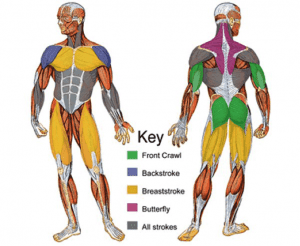
Image result for body shapes freestyle vs backstrokeConsider different strokes. It is obvious, or at least should be once you stop and think about it, that breaststroke utilises different muscles to free style. Just have a look at the body shapes of Olympic swimmers. The demands the strokes place on the wrist will change as shoulder position changes. Feathering of the hand through the water will also alter. Use this to your advantage. If one style is inflammatory, can you integrate another so that swimming fitness is maintained throughout recovery? There will be a way.

If you have been told to wear a splint or brace, can you swim with the splint on without posing a risk to how that injury will heal. Paddles can actually help protect a hand fracture, but need to be got used to. I have seen a couple of mallet finger injuries of late caused by hitting the wall too hard. One patient opted not to swim and COVID-19 closing the pool helped with that. The other was a keen open water swimmer. Stupidity personified given it is winter here and the bay sits at around 14 degrees Celsius. However, I'm not judging, really.

The answer here was working out a solid taping protocol both over and under the splint. We also spent some time discussing skin care as the risk of maceration and subsequent skin breakdown was high. Finally, we practiced donning and doffing the splint in the clinic until it could be done confidently without me saying a word.

Water exercise is important for so many reasons. The act of immersion itself can be healing, offering pressure differentials and sensory stimulation, that can reduce oedema, sensitivity, and pain. If you need to get back in the swim, I'm pretty confident that with the right advice, you can.

Look after those fingers,

Hamish 


Tuesday, 8 September 2020

Iso's in Iso: Beyond the Ball

If this isn't the best title for a blog piece on grip strengthening this year then I'll give it all up. I actually don't have much more than the title actually. Sorry. I've spent most of the morning thinking about how I help patients regain hand strength. What special tools do I utilise and what is the science behind these unique methods? Sorry again. I've got nothing for you beyond gut although I'm sure there is some science out there. 


When we talk grip strength, much of the conversation is based around differentiating between power grip and precision grip. Both types then get torn up into even more specifics. Power grip has 4 forms apparently. There's cylindrical grasp, ball grasp, hook grip and lateral prehension (thumb adduction). Pinch also has 4 forms, precision, oppositional, key pinch and chuck grip (1,2). So when I get a patient referred for rehab with the suggestion that "maybe a stress ball would help", it's hard not to feel a little superior. 

We can do better than a stress ball because rebuilding a functional hand requires more than 10 repetitions of a ball grasp 3 times a day. In fact, if I'm speaking plainly, I almost never prescribe stress ball squeezes. I find that often this type of grasp neglects to include the long flexors and the ulnar digits. Instead, I'll find strengthening exercises that replicate most what that patient needs to do and then build from there. If that's swinging a hammer, the initial focus may be on cylindrical grip. If that's holding a football, then working on a more open, ball grasp with its emphasis on intrinsic stability. If it's climbing a wall, then hook grips and flat pinch come into play. 
Not my arms, those who can do etc

My current favourite is the rice bath. It encourages composite wrist and hand movement, it facilitates all grip and pinch types, and there's a sensory component to it as well which may assist with proprioceptive feedback. The key is variation regardless of what you prefer. Use a ball, but also use a rope, or encourage wringing of a wet towel. Isometric holds of a barbell will build hook grip strength, but hanging from a chin up bar will encourage cylindrical grip. Remember that there is a clear correlation between grip strength and shoulder stability(3). Work in pronation and supination, sitting and standing, shoulder abduction and flexion. 

So, no science, but some sense. Have a look at how your patient grips. Use a rolled up bandage instead of a ball. Use a pillow or a handle. Empty 5 kilos of rice into a bucket. Look at what's not working, at what they need to do, and go from there. "Isos in iso", brilliant. Should have been in advertising! 

Look after those fingers,

Hamish

(1) Duncan S. et al. Biomechanics of the Hand, Hand Clinics 29 (2013) 483-92
(2) Landsmeer J. Power Grip and Precision Handling, Ann Rheum Dis 21 (1962) 164                                                          (3) Horsley I. Do changes in hand grip strength correlate with rotator cuff function? Shoulder Elbow 8-2 (2016) 124-9

Tuesday, 18 August 2020

Ways around a problem. Getting into Hands.

Greetings from lock down. Over the past couple of weeks I have listened to a number of webinars and participated in two. A quick shout out to the team at HandSpark, Beth and Ngaire for their initiative in creating the hand therapy summit with 9 speakers over 3 days. It has been well worth tuning in to. 

Beth & Ngaire from HandSPARK

I have also been involved with an Introduction to Hands webinar that the Australian Hand Therapy Association did last weekend, and also one on Hand Injuries to the musician and Athlete that I did with Karen Fitt from Melbourne Hand Rehab for the students group at the Australian Physiotherapy Association. Whilst both presentations provoked a range of questions from the participants, a common one was "how do I get into hands?". 

It's a tricky question to give an answer to as there is no consistently direct pathway. We no longer have a post graduate course in Australia due principally to bean counters at the universities, not due to lack of support from potential teachers or students. Several private groups have stepped into the breach, and alongside the education offered by the AHTA, there are now private graduate fellowships and workshops available. Travelling overseas was how I found my way in, but will that be an option for others? Maybe not for a while. What else... 

Lots of great courses here...

In a flash of laziness, I remembered the podcast I did with Jack Williams some months ago now in pre-COVID days. He  had followed up with a summary of our conversation with an emphasis on that very question that I always intended to publish, but never did.

Here then is a guest piece by Jack Williams. Please do have a listen to his podcast especially if you are a young therapist on the cusp of, or just starting your career because he talks a lot about opportunity and how you can shape your direction and path. Thank you Jack...

Hello Sporting Hands readers...

I first came across Hamish's blog in 2017 as a student physiotherapist and thought it was a great learning resource which really helped me whilst I was on a hospital orthopaedic / hand therapy placement. 

Hard to find a photo of Jack

I really enjoyed our chat and I promised Hamish to make a contribution to the blog which has proved very helpful over the years! I thought I would leave the sporting injuries to the experts and write about getting experience in hand therapy as I recently hosted a podcast with Hamish talking about this very subject...

You can listen in to the podcast here...

https://linktr.ee/Healthlinkd

I am fascinated with Hand Therapy for many reasons...

  • Did you know Brian Mulligan’s “apple on the head” moment for the development of his mobilisation with movement manual therapy techniques occurred when he was working with a stiff PIPJ?
  • Splinting is widely considered the defining factor of a hand therapist - but as Hamish says - splinting skills constitute a very small proportion of the job!
  • Hand therapists have a specialised knowledge of physiology, anatomy, neuroscience and orthopaedic knowledge which is unrivalled by other spheres of OT and physio.

Maybe this is why getting a position in hand therapy is so competitive... these skills are not taught at university and private practise educators and mentors are hard pressed for time to impart such knowledge...

Which brings me to the point of this article…

What are some things a student or new graduate OT/PT can do to get a training position in Hand Therapy?

The AHTA runs a number of special interest groups in each state, getting along to as many of these as possible is a fantastic learning opportunity and also good for networking... as a student it is recommended that you find out where your nearest SIG group is and get along!

Approaching a private practise as a student and doing some observation is a good way to get your foot in the door and learning about what is required for a private practise role. If you are volunteering for a period of time - this should not exceed more than a few months and be sure to make yourself a part of the team’s professional development in-services and other learning opportunities.

There are also a lot of overseas training in hand therapy available in the UK. Hamish first started working in NYC as a hand therapist and also notes that many early career and experienced OT / PT's are able to find hand therapy training positions and work in London and other parts of the UK.

The AHTA also runs a number of courses for OT/PT's who are interested in training in hands - they are for people looking for professional development in hand and upper limb MSK and students and new graduates are welcome to attend - even without much experience in hands... getting started early with one of these courses will stand out on your resume - particularly with the new pathways for 'Accredited Hand Therapist' come into play and both private practise and public employers value this certification for leadership positions for hand therapists.

The are many exciting prospects in the future for Hand and it is certain that this area will remain distinct moving into the future... Hamish also talked about what is in store for hand therapy on the podcast as well as 3D printing of splints and places for hand therapists in professional sports... You can listen in here...

@Healthlinkd | Linktree

It was great to visit the Heidelberg Repatriation Hospital and put a face to a familiar blog...

Thanks again for coming on the podcast Hamish!

Jack

Thursday, 9 July 2020

Just When I Think I'm Out...

So close. There was always talk about a second wave, but we all thought we'd be right. Well I did. So did, obviously, those who started to flout sensible advice like washing hands and social distancing. The result is that the city I live in has gone back into lockdown. I can't escape to the beach for a surf this time either. It's a hardcore lockdown. Not that the idiots running around the park this morning in packs of 4 to 8 seemed to think anything of it. I didn't say anything; just crawled into my little car and screamed at the world. 


Raynauds, keep it simple.
It's hard to build back into the mindset I had for the initial lockdown. I was pretty productive then. Updated website, updated protocols, video consults, research paper, a bit of learning. Even made a street library and stocked it with old books. The patients that did come through got extra attention and great results. Numbers started to climb and so did my confidence in myself and my clinics. Then everything stopped again. Just, like, that.

A full session yesterday was cut by 75%. I was so cranky. Then Carol bought me a croissant. Then Antonio walked past the clinic with wave and a ridiculously big grin on his face. He does that every day at 9:15am. He said his hands were cold. I couldn't understand much else given the mask and his Italian English, but the fact that his fingers were white meant he was probably a bit uncomfortable. I grabbed a pair of arthritis gloves, put them on him and sent him on his way back down the road with his wheely walker and his smile. 

And then I had a young patient who had never had any help following a traumatic elbow fracture dislocation whilst playing footy ten months ago. He'd regained full movement, but it was a bit clumsy, his strength was off and his sensation was messed up. All he wanted to do was to play footy again, and get ready for the cricket season. Given the fact that he was pretty much an open book, the question was where to start. 


Thank you Alison #walkadifferentdirection
We did a lot of talking. He asked a lot of questions, I offered reassurance and something different for me, Kinesiotape. Now, I'm not going to say that Alison Taylor is a genius, even if she wanted me to and even though it may be true. I missed her presentation at the Asian Pacific Hand conference due to COVID so have been looking at and trying to work out some of her treatment methods online. I must admit, much of it I don't yet understand. I do understand and appreciate her primary message though. That message is that she gives us all as clinicians, the power to say "I'm going to have a crack at that", even if we haven't tried it before and even if it's not at the top of our usual toolbox of techniques. So I taped.

Ulnar to radial dorsal glide just distal to Guyon's canal. It worked. Not exactly sure why, but I think I know, and I know I'll work it out. I'll definitely try it again. Thank you Ali, thank you www.handtherapyed.com Tape may not be the answer next time, but something else will be. The sun will come up tomorrow everyone. Keep trying new things, keep smiling and eating croissants, because being cranky helps no one.

Stay safe and look after those fingers,

Hamish

Tuesday, 28 April 2020

Corona Resolution #1: Learn stuff


Stallone, Sylvester [Cliffhanger] photo
One cannot climb in isolation...
My big Corona virus resolution was to formalise my ulnar sided wrist pain rehab progression. As I worked on this, much like a lot of my thinking, the initial concept I had morphed into something much bigger and more unwieldy. So often as hand therapists we talk about the need to assess and treat the whole arm, not just the end of it. There is no good having a wrist that works if the shoulder that is designed to put it into space can't do that. But, there is no point in having a shoulder that works beautifully, if the wrist lacks coordination and stability. The problem with realising this, is that assessment of upper limb issues typically is done by examining each part individually, not as a whole. So are there measures that look at whole arm movement and function, not just bits? 


Nice guns Rafa, shame about your wrists...
Screening tools used in elite sport include the 9+, the United States Tennis Association High Performance Profile, and the Functional Movement Screen. Unfortunately, these are all predominantly lower limb and balance related. The USTA one for example is made of of 10 tests. Three look at the shoulder in isolation. 6 look at the hip and legs, again mostly in isolation, and one assesses the core. There is no reference to anything elbow, wrist or hand related, and no way to even examine them even accidentally, in spite of the fact that injuries to these areas make up 10 to 24% of injuries within the sport(1,2). 

A bit more digging and I discovered some tests with potential. A bloke by the name of Matt Redshaw posted a presentation he had made that discusses assessment with a view to returning to play (thank you Matt)(3). Again, it is a shoulder heavy piece, but I couldn't help wondering if some of the tests could be used to look at whole arm performance. The two with the most promise are very similar in nature.

The single arm seated shot put, and the seated medicine ball throw both measure the ability to push a weighted ball through the air. Distance is measured, the results are compared to norms and, in the case of the shot put, to the non-involved arm with an expectation of 90% symmetry. The test requires an extended wrist and hand that flexes as the arm extends in order to propel the weighted ball. Simple, sort of functional, providing immediate and relevant feedback to the patient and therapist (4). 


Fibonacci in the hand
Its application made sense to me as I wondered why I am seeing so many rock climbers with trigger fingers. Ben Cunningham, a local hand therapist whose wisdom I respect, reasoned that this is probably due to an intrinsic vs extrinsic muscle imbalance, and therefore a dysfunction of the Fibonacci sequence. Also known as the Golden Ratio, this famous sequence occurs frequently in nature and mathematics. It refers to a sequencing of numbers where each number is the sum of the two numbers that preceded it eg 0,1,2,3,5,8 etc.

Whilst the ratio has been disproven with regard to bone length in the hand (5), it still seems relevant when applied to hand movement. Here, it describes how during finger flexion, the motion paths of the digits form an equiangular spiral. Ben's argument is that this predictable & balanced progression of angles, whilst applicable to full grasp, is disrupted during specific climbing holds like the crimp. This then exaggerates the forces, disrupts the relationship between muscle groups, and leads to overload and failure. 


Not true. Just keep doing this. Stay safe & well.
Now Ben is a very wise man, and whilst he possibly has something there, could it also be the result of a more proximal deficiency? Either way, hand and wrist pain in climbers is usually the result of overload causing poor technique, and subsequent biomechanical failure. Establishing a baseline of whole arm power might prove useful even if the assessment itself is not as obviously applicable as a timed hangboard test. My suggestion is that in addition to examining individual parts, we test muscle power and efficiency with whole arm active testing. Dynamic tests like the seated shot put or medicine ball throw might be part of the answer. I'll keep playing around with things, but in the meantime I would love to know what others are using. 

Look after those fingers,

Hamish


  1. Targett, S. Periodic medical assessment of athletes. In Brukner & Khan, Clinical Sports Medicine Ch 46. 5th Ed. 2017. McGraw-Hill.
  2. Abrams,G. Epidemiology of musculoskeletal injury in the tennis player BrJSpMed 2012
  3. Redshaw, M. https://www.manchester.edu/docs/default-source/fort-wayne-docs/neisms/2017docs/matt-redshaw.pdf?sfvrsn=2
  4. Riemann, B.L., A bilateral comparison of the underlying mechanics contributing to the seated single-arm shot-put functional performance test. Journal of Athletic Training 2018;53(10):976–98
  5. Park, A.E.,The fibonacci sequence: Relationship to the human hand JHand Surgery, 2003  https://doi.org/10.1053/jhsu.2003.50000


Tuesday, 21 April 2020

Telehealth; the New Normal?

Lauren Miller, amazing what a deadline can do!
Telehealth can be awesome but has inherent limitations. Like so much of what I do, it requires practice and it also requires a buy in from both therapist and patient. I spent a bit of time helping Lauren Miller out with a review paper on telehealth and hand therapy she punched out for the AHTA. I've pasted the introduction below. The paper demonstrated that there is established proof that telehealth can be a viable and effective treatment modality. I would agree with this, albeit we need to recognise that it does have limitations. I'll let you read Lozza's work first, then I'll add my 5 cents. 

Evidence of clinical effectiveness of telehealth consultations by Hand Therapists: for the consideration of Private Healthcare Australia, Lauren Miller, PhD1,2, Hamish Anderson3,4, Andrea Bialocerkowski, PhD 5,6

Hand Therapy and Coronavirus (COVID-19)

Hand Therapy is the science and art of rehabilitation of the upper limb from the shoulder to the hand. It involves the assessment, using standardised tests, of the injured limb from which a specific treatment program is designed (Australian Hand Therapy Association, 2020). A variety of specialised treatment techniques are used to achieve client goals. Hand Therapy is practiced by occupational therapists and physiotherapists, and traditionally occurs in the face-to-face delivery mode.

However, in the wake of the coronavirus (COVID-19) pandemic, measures aimed at controlling the spread of the virus within our community have been introduced. These include social distancing of at least 1.5 metres between individuals, advice for people to stay at home (particularly those aged over 70, or over 65 with pre-existing conditions, or Indigenous people aged over 50 with pre-existing conditions) and self-isolation for those who have recently returned from overseas, tested positive, or been in contact with someone who has (Australian Government, 2020).

These important measures present significant challenges to the traditional face-to-face model of care. Telehealth consultation provides an alternative and in many cases adjunct option that enables continued access to Hand Therapy services and prevents unnecessary delays in receiving care while minimising risk of coronavirus (COVID-19) disease transmission. Telehealth consultation may become even more crucial in the event of more restrictive lockdowns, such as those being enforced in other countries.

Fortunately, the Australian Hand Therapy community is well placed to introduce safe and effective telehealth consultations. The use of telehealth has been repeatedly shown to be efficient, cost-effective, and able to deliver the results that Australian Hand Therapy consumers demand, and deserve. It is the strident view of the Australian Hand Therapy Association that to enable privately insured patients to access appropriate and effective health care during the restrictions of this pandemic, hand therapists need to be able to bill private health insurers for teleconsultations.


Ordinary meme, but pickings were slim
The issues I have faced are mostly addressed in the article. They include poor display quality that means I can't tell if a wound is infected or just angry, reluctance on behalf of patients to actually pay for my time, and the inability to repair a splint over the internet. The evidence does exist to justify telehealth as a modality. My immediate problems are twofold. 


Number one is that with no one playing sport or doing risky things, with no elective surgery, and with no one visiting a GP for anything other than a fearful sniffle, I don't have patients knocking on my door at the moment. I do want to utilise telehealth but I don't currently have a patient population to use it on. Bigger practices, those associated with trauma surgeons, and those who pre-pandemic had established exercise classes may be different. Good luck to you all. Also what can't be effectively addressed is a perceived inability on my part to translate what the patient needs to do without being able to physically put my hands on them. I'll learn that if I get the chance to persist, perhaps in the  post COVID-19 world. Ultimately, the valuable lesson for us all is that it is an option, and is likely one that should be be added to most therapy tool kits from here on. So well done Lozza, and thank you.

Look after those fingers,

H

Tuesday, 31 March 2020

Madness in the Time of Corona


Hates a microphone!
Six weeks ago, I wrote about how things change. I was diving back into private practice after 3 years of mostly working at a public hospital. The Corona virus was on the radar then, but it didn't appear to be influencing anybodies plans unless they lived in Wuhan, and it certainly wasn't shaping mine. For me it was full steam ahead. Loving being back at the Hawthorn footy club, and relishing the challenges associated with working with the Carlton AFLW team. I was also at the pointy end of having been the co-convenor for the, wait for it, triennial combined meeting of the Asia Pacific Society for Surgery of the Hand, and the Asia Pacific Federation of Hand Therapists here in Melbourne. 
Do they miss me as much as I miss them?

We were expecting well over a thousand registrants for this conference. As we got closer to the event date of March the 10th, those numbers started dropping. First the Chinese delegation pulled out, then Singapore, Korea, and much of Japan. When the Grand Prix wasn't cancelled, we took this as a green light to continue. At the same time, we spent a lot of time arranging video presentations, and the schedule took a massive hit. 

The conference went extremely well. Minimal contact, but not nearly to the extent we have now. A challenging program amidst a backdrop of impending doom. The call to cancel the final day was made at three o'clock on Friday the 13th. Apt perhaps. There was disappointment, but no complaints that I was aware of, and I can only thank the delegates for that. The gala dinner went ahead, and as Alison Taylor said, it was kind of like the last party on the Titanic. It was certainly the last party I'll be at for a while. 

Ripping tune
I've now lost my contract at the footy clubs and my practice has shrunk to half of what it was. I still have people coming through the door, but I'm restricting that as much as possible to post-operative cases. I've read comments about how we should shut our doors completely or just offer tele-health, and I can appreciate where they are coming from. However closing the door on a person just after surgery and having them rely on surgical advice to "just start moving when you feel like it" is likely condemning them to a crap result. Tele-health is great for some and I've used it to reinforce & adjust programs, but it can't work for everyone. So I'm still open. 

But it's weird isn't it? It's surreal. Streets are empty. Toilet paper has made a return, but you can't buy more then two tins of vegetables even if you mix the types, and there's nothing in bulk. Spotify is chockers with Corona Isolation playlists. The memes that are flying around are mostly hilarious, although I get the impression that the edge to them is getting darker and nastier.


For a positive sporting fix
When I'm not working on the business I'm watching anything on Netflix I can that's sport related. Just finished "The English Game". Acting was ordinary, but the story was fascinating. There's a series of ESPN documentaries called "30 on 30" that I'd love to work through, and I've found several podcasts one of which, "The Howie Games" is a surprising stand out. I'll do some exercise, go for a run, hit the lonely speed ball, and have a kick with my son. I'm also working on a passable version of "I Useta Love Her" by the Saw Doctors. Classic happy space song. It could be worse, and so it's not me I'm worried about. 

Here's where a blog that is determinedly light-hearted and irreverent becomes sombre. I worry for those who don't have my resources. I worry for Mum and Dad. I worry for the mental health of so many. I worry for the long term implications of this virus: socially, financially, and physically. I worry for my friends working on the front-line in public health both here and overseas. I don't worry for the dickheads who think they are above it all and can do whatever they want. Karma will get them.

So stay safe, look after your fingers, and I'll see you on the other side of this madness. 

H

Monday, 17 February 2020

It's all about me now!


So as you may have noticed, I never fulfilled that promise to complete the triathlon series, nor did I update the blog as regularly as I should have. 2019 was a year of massive upheavals for me and mine, and things certainly got away from me. I did however complete the same triathlon this year. I was faster this time, and I’ve emailed the race organiser Adam Beckworth (www.beckworthracing.com) to get his 10c worth on triathlon and hand injury. Hopefully that will all work out! 

In the meantime, with the unashamedly self-centred goal of self-promotion, I’m going to use this blog to discuss my rationale associated with diving back into the perils of full time private practice after three years of working predominantly in the public sector.

Thanks again to Hoggie of Andrew Hogg design
When you are solely responsible for bringing food to the table and can’t just expect to be paid for showing up, a whole host of issues aside from the ability to fix fingers arise. You have to understand marketing. You have to understand budgets. You have to understand relationships with referrers. You may not want to admit it, but because your relationship with your patients is fee for service, sometimes your role becomes mercenary. These conditions are what you sign up for. The reason I went to work at Austin Health as their senior clinician in hand therapy, was because 15+ years of mostly independent private work had worn me out. 

At Austin Health I had a great team of therapists to lead and teach. I also learnt from them all, regardless of their experience. I got paid regardless of whether a patient showed or not. I could manage my time to include extra projects and research and was supported to do so. I enjoyed my three years there because of the people, both the other therapists, and the patients. Ultimately, the reason I left the financial safety of a permanent position, was because Austin Health could never give me the career control I had when I was my own boss.

Go the Blue Baggers!
Within two weeks of leaving Austin Health, I was consulting with a wheel chair athlete at the Australian Open. I also took the opportunity to work directly and regularly with the Carlton AFL womens team, in a very similar role to what I do at the Hawthorn footy club. I got busy establishing three new clinics. Two of these are in busy sports physio practices; one is in a rock-climbing gym! I am chasing provider numbers, new equipment, and new stationary, not to mention new patients. I am writing to potential new referrers. I am working on “establishing a social media presence”. I am getting control back. 

I am getting control back by doing what I love to do, in the manner in which I love to do it. Yes there is a financial risk; I don’t anticipate I’ll be flying first class anywhere anytime soon. But I’m challenging myself again much as I challenged myself in the Barwon Heads triathlon last weekend. Life is simply too short to doubt yourself or your ability to do what you want to do.

Until next time, look after those fingers,

Hamish

Thursday, 23 May 2019

Triathlon & Hands

Image result for matt hopkinson physio
Matt Hopkinson. Ordinary triathlete, elite dancer!
I was recently chastised in a nice way by my “landlord” Matt Hopkinson. Matt is the owner and principle physiotherapist at “Glenferrie Sports and Spinal” which is where I work every Monday afternoon. Matt, and Ben Holland the peoples’ podiatrist, had just returned from a weekend in Sydney on practice management, and in particular, the use of social media. Matt had a crack at me for not keeping my presence on social current. He’s right of course, it has been 10 months since my last blog, and so I promised him I would get something down. 

The something that has been buzzing around in my head is the result of a triathlon I completed in February. Around the same time, I saw an elite triathlete, who had had an extremely nasty injury to her wrist after a fall from her bike. The injury, whilst it didn’t necessarily stop her from training, certainly impacted on how she trained and what she could do.

Image result for clip art triathlonTriathlon is a sport that demands different things from the body at specific times. There are things that are similar between the disciplines, eg cardiovascular fitness; and there are things that are different such as the demands on upper body in swimming that are not there in running. I would argue, and I will argue, that a wrist or hand injury can impact all three; swimming, cycling, and running. 

I first saw triathlon on the Saturday afternoon TV show “Nines Wide World of Sports”. The Hawaiian Ironman. This race began in 1978 when Judy and John Collins proposed combining the three toughest endurance races in Hawai’i—the 2.4-mile Waikiki Roughwater Swim, 112 miles of the Around-O’ahu Bike Race and the 26.2-mile Honolulu Marathon—into one event. 15 people raced that year, 2400 last year in what is now a qualification only event (1).

It really is that colour. Swimming through goose poo.
My first triathlon was in 1985 around the Kew Boulevard. We swam in the Yarra River which is revolting now I think about it, and I was 296th out of the water in a field of 300. Jumped on my trusty but rusty 10 speed Lawrencia bicycle with its pack rack still attached and rode my guts out. Did okay in the run and ended up in the First Aid van with cramp at the end. A fantastic morning and whilst the experience never led to a lifetime of racing, I’ve always loved the sport.  

In the next blog (and it will be up very soon), we’ll talk about swimming, my least favourite leg but an important one for fingers!!


(1) http://ap.ironman.com/triathlon/events/americas/ironman/world-championship.aspx#ixzz5onGPe21q

Thursday, 19 July 2018

One screw or two?

It's getting towards the end of the Australian rules football season. It always seems around now that I see more people with hand and wrist fractures than I did at the start of the year. maybe it's the cold, maybe it's fatigue, maybe it's that the games become more desperate with finals around the corner. Surely someone knows?

Better in brown & gold! Scaphoid 2016.
In any case, this week I have seen 4 footballers with scaphoid fractures. All were simple non-displaced waist fractures. Two were casted, two had surgery. One of these had one screw inserted to repair the bone, the other two. A physio I really respect asked whether the two screw thing was new, and why would the surgeon opt for what appears on the outside to be much more difficult surgery to a small bone that already has a poor reputation for healing. The surgery and the science weren't new to me, but a translation of their impact was obviously required so let's start at the start. 

Facts about the Scaphoid (1,2)
Scaphoid fracture through waist. One screw, result at 4mths. Not my patient.

  • Most commonly injured carpal bone
  • Frequently diagnosed late if at all, with high rates of bone non-union
  • Best assessment indicator remains pain on palpation of scaphoid in radial snuffbox (below thumb)
  • The part nearest your wrist (proximal) has poor blood supply, often lost with a fracture of the middle section (waist)
  • Casting can be required for 2-6 months
  • Surgery appears to have better outcomes in the short term
  • It appears thumb immobilisation is unnecessary in a cast (3) (but I still include the thumb at least initially because I definitely don't trust young, male footballers!). 
Not an option in Aussie rules footy!!
If I am just talking about athletes, then they are looking at the quickest possible return to their sport. This makes a fracture during the season more likely to be addressed with surgery in spite of the real risk of complications. There remains a risk though. Surgery will ensure good bone compression and stability, but the bone still requires protection in a splint, and active movement outside of the splint is not always encouraged such is the reputation of this poor little bone (1,2)

The reason surgeons started looking at two screw fixation was that they wanted earlier movement at the wrist to reduce concomitant weakness, and there have been significant improvements in available hardware since development of the Herbert screw in 1984(5). There was also a recognition of the potential benefit of permitting controlled stress across the joint to augment bone growth. 

Cupcake bouquets. Who knew they were a thing?
Keen students of previous blogs will be aware that the scaphoid is a tricky little beast, not always moving in a singular plane. The problem with a single screw, was that it still permitted rotation of the scaphoid. Proponents of the two screw method argued that torsional stability of the bone would be enhanced with two points of fixation (4,5). This makes sense to me. One toothpick in a cupcake bouquet and the cupcake will slide off. Two toothpicks and it can't. Simple! 

Obvious complications are that inserting two screws is technically very difficult, it effectively doubles the likelihood of malpositioning, and it is more expensive (4). It is a new technique; one that is not available to all patients, and one that is not yet supported definitively. Rehabilitation protocols specific to this surgery have not yet been established. 

Notwithstanding the risks, and relative newness of the research, the biomechanical theory comparing one vs two screws is promising. Both lab based and clinical results do indicate a better stability, stiffness and energy absorption compared to a single screw. Whilst these studies concentrated on scaphoid fractures involving non-union or displacement, the implications are that an earlier introduction of mobilisation, loading and strengthening may be tolerated (4,5); possibly even an earlier return to play... just in time for finals!

Look after those fingers,

Hamish


References
  1. Rambau GM et al. Evaluation & management of nondisplaced scaphoid waist fractures in the athlete. Operative Tecniques in Sports Medicine 2016 24:87-93
  2. Winston, M., Weiland AJ. Scaphoid fractures in the athlete. Curr Rev Musculoskelet Med 2017 10:38-44
  3. Buijze, GA. et al. Cast immobilisation with and without immobilisation of the thumb for nondisplaced and minimally displaced scaphoid waist fractures: A multicentre, randomised, controlled trial. JHS Am 2014; 39(4):621-627
  4. Mandaleson, A. et al. Scaphoid fracture fixation in a nonunion model: a biomechanical study comparing three types of fixation. JHS Am 2018;43(3):221-228
  5. Garcia RM. et al. Scaphoid nonunions treated with two headless compression screws and bone grafting. JHS Am 2014;39(7):1301-1307


Sunday, 28 January 2018

Low to High Hamma, Low to High

John Egan; back 2 back 2 back winner of the
Cannons Mark of the Year
Gary Coleman Cup
My mate Jumping Johnny Egan is one of the best marks of a footy that I have ever seen. As he launches himself towards the ball, his hands move from down by his waist into the air above his head before snapping open with wrist extension just before the ball smacks into his palms. Conversely, and keen readers of this intermittent blog will know exactly where I am going with this, I am one of the worst marks of the footy I have ever seen. At least, I used to be.

The local junior footy club (Go Sharks) began to run training nights for Dads. There was no game, just an excuse to run hard and do circle work. One night, in the middle of another ball dropping performance beyond belief, the bloke running the show pulled me aside and asked if anyone had ever taught me how to mark a footy. Before I’d even had a chance to realise that he wasn’t taking the piss, Jacko proceeded to outline exactly what I needed to do. I needed to be more like Johnny. 

Talk about "Low to High" Poppy!!
When Johnny marks the ball, his hands aren’t coming up from below the ball’s trajectory. Instead they are coming towards the ball but in such a way as to offset the trajectory and speed of the ball so as to give his hands as much time as possible to grasp it. Now that’s not what Jacko told me, but it is what he meant when he said “Low to high Hamma. Low to high mate”. It is however what an Italian neuro-physiologist found in a mind numbingly involved article with the disarmingly simple title, “Grasping and Catching” (1). 

Catching is a combination of predicting the velocity and path of the object, adjusting proximal structures in such a way that grasp of the object is possible. Experience helps which probably is one reason the recent explosion in girls playing footy has seen a similar explosion in finger injuries within that cohort. What also helps is visuo-spatial ability, which is a little more difficult to train up if you haven’t been gifted with it to the same ability as Jumping Johnny. 

Above: Mind you, a sticky glove helps too... right Clokey?
Below: I don't need one says Roughy!
Whilst the article is at pains to point out differences in catching ability between professional and amateur sports people, it does indicate that a combination of training, technique and experience can make a difference. It is all about maximising the time you have getting your hand into position before it needs to grasp the ball to hang on to it which may be why an over hand catching technique proved more reliable. This technique may not be transferable to Australia’s greatest game in every instance, but the concept is, and getting your hands into position is the best way to start. 

Look after those fingers,

Hamish

(1) Cesqui, B. et al. Grasping in one-handed catching in relation to performance. PLoS OneJuly 2016


Tuesday, 5 September 2017

The Stress is Killing Me

A lot of trees have been sacrificed in the name of better understanding bone stress injuries to the lower limb. Brukner and Khan’s latest edition of Clinical Sports Medicine devotes a whole chapter to their management... in feet.  Admittedly with good reason; they are debilitating and difficult to treat.  However, at the risk of being seen to harp again on my favourite theme of “what about the hand”, what about the hand? If B & K don’t mention them, and do they even exist? 

The answer is of course yes, it’s just that they are rarer. A Spanish paper in 2010 reported that only 12 cases of stress fractures to the metacarpals had ever been written up. The authors of that paper then published a case series of 7 tennis players with stress fractures of a metacarpal. All were adolescents, and all had altered their training or some aspect of their game prior to this injury (1). Volker Schoffl, that rock-climbing, x-gaming hand surgeon in Germany also published a paper on bony oedema in climbers (2). Aside from that there are a few case studies, but not a lot.

I've got almost too much in common with this guy!
So if they’re not talked about much, are we talking about the same thing? Well, essentially yes. B & K devoted a chapter to this subject; I’m going to try to paraphrase them in 150 words. Actually, I’m just going to copy what Stuart Warden wrote because it’s nice and succinct… (3) “A bony stress injury (BSI)represents the inability of bone to withstand repetitive mechanical loading, which results in structural fatigue and localised bone pain and tenderness. It occurs along a pathology continuum beginning with a stress reaction, which can progress to a stress fracture, and ultimately a complete bone fracture”. Thank you Stuart. Of course there is a lot more too it, and his chapter is a good read so get into it if you want to know more. 

Should be obvious.
MRI stress #. Not my patient
(4)
“Treatment then is what?” I hear you protocol driven fiends out there screaming. Rest and controlled load says Stuart, among other pearls. But let me make this a bit more personal, this is what I did...
·    Tennis player, bone pain in second metacarpal, had come on strongly over the period of a clay court tournament but had likely been festering for some time. Essentially the pain was so severe he could no longer hold his racquet and hit a forehand with any force. Stress reaction confirmed on MRI, dorsal interossei inflamed also which made anatomical sense. 

·         -Weeks one to two, rest in hand forearm orthosis overnight, hand based radial metacarpal joint immobilisation orthosis during the day, coming out for gentle range, modalities and very light massage only. Pain with turning on tap.
·         -Week three initiate very light isometrics to the interossei. Shadow racquet swings with large diameter light cardboard roll – NO PAIN. Decreased splint use, taps almost ok. Continue overnight splinting, stop day splint.
·         -Week four introduce light grip vs theraputty, continue to build load. Roll ball on racquet head. Grip rolled up towel.
·         -Week five to six, continue to build load, isometrics well tolerated now, introduce graded hitting ie soft balls, no forehands just yet. Progress putty density, light gym weights.
At this point, I passed him back to the tennis physios as the interossei were now pain free to heavy loading, although forceful grip was uncomfortable especially when hitting, and he still had pain with palpation of the second metacarpal. However my outcome measures had all been met, and it was felt he needed to focus on the tennis side of things.

Not my patient btw. Just a funny photo.
It is now 4 months since he last hit a tennis ball in anger, but he has finally been given the green light to resume competition. That’s a long time off for something that was initially seen as a short term reaction to increased activity. The time frame does does however, fit published case studies (1,4). It’s also likely that this stress reaction was in fact a fracture. I can absolutely guarantee that if any of the team involved with this injury come across any similar injury that occurs in another tennis players metacarpal will be taken just as seriously as if it had occurred in a metatarsal. “What about the hand” indeed! All part of my cunning plan. 

Look after those fingers,

Hamish

(1)    Balius, R. et al. Stress fractures of the metacarpal bones in adolescent tennis players: a case series. American Journal of Sports Medicine 2010 38:6 pp 1215-1220
(2)    Hochholzer, T., Schoffl, V. Overuse bone marrow oedema of the hands in sport climbers. Sport Orthop Traumatol 2013 29:3 pp 219-24
(3)    Warden, Stuart. “Sports Injuries: Overuse” in Brukner, P & Khan, K. Clinical Sports Medicine 5th ed. 2017
(4)    Duarte, M. Metacarpal stress fracture in an amatuer tennis player; an uncommon fracture. Revista Brasilera de Orthopedia June 2017.